Writing anything about Ralph Greenson that doesn’t paint him as Satan-incarnate will undoubtably bring out the rock-dwellers, but I don’t choose to shy-away from sharing things from a different perspective. I’ll preface this by sharing how I too once got on the Greenson hate wagon, convinced he loomed over Marilyn like some Svengali. However, over my last decade (!!!) of archive work, I’ve come to appreciate Greenson as a misguided yet caring man who simply couldn’t see the forest for the trees when it came to his most notorious patient.
A common narrative puts Greenson as some google-eyed hack who seduced Marilyn (definitely mentally, sometimes physically) with some pseudoscience nonsense. On the contrary, Greenson worked with some of the biggest names in Hollywood, including Tony Curtis, Marlon Brando and Vivian Leigh. Would his treatment methods pass an ethics board today? No, definitely not, but at the time, Greenson received respect in the psychiatry world as a thought-leader. With this in mind, it’s not shocking Dr. Marianne Kris recommended him to Marilyn while the latter worked on The Misfits.
Pre-1961
Before Marilyn became a full-time patient of Greenson’s in 1961, she worked with him for psychiatric guidance on Let’s Make Love and to cutback on her pill addiction during the filming of The Misfits. Greenson had experience working with celebrity pill addicts, so it’s not shocking Seven Arts Productions found him a great fit for helping Marilyn dry out while they secured additional funds after the film’s budget got blown by John Huston at the craps tables. The psychiatrist and star’s bond seemingly solidified during The Misfits fiasco.

1961
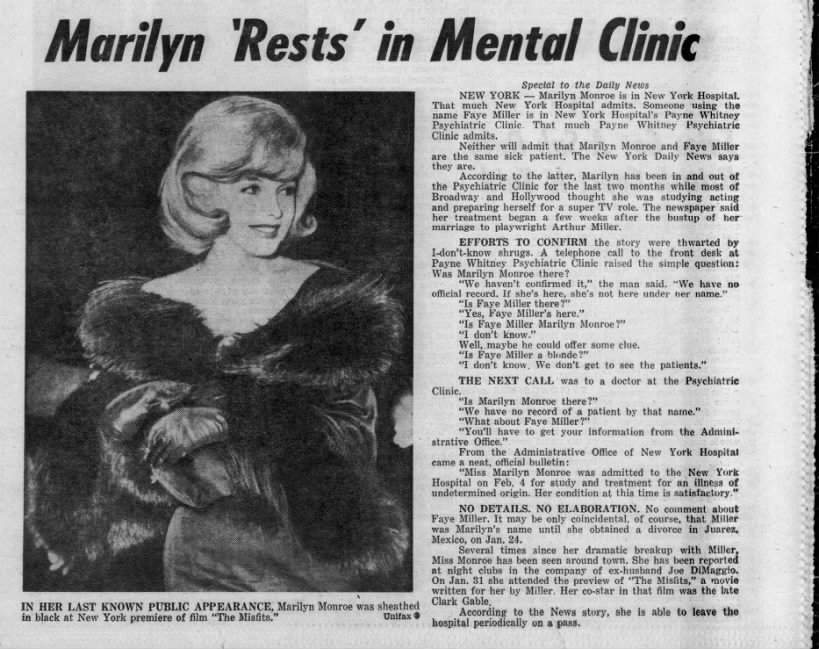
Marilyn got admitted to Payne Whitney Psychiatric Hospital on February 4, 1961, on the recommendation of her New York psychiatrist, Dr. Marianne Kris. Kris reportedly found Monroe’s suicidal tendencies and ever-worsening pill addiction alarming and decided institutionalization might hold the key to getting Marilyn on the right track. Marilyn’s admittance to the hospital got confirmed by the Daily News on the 9th, five days after later:
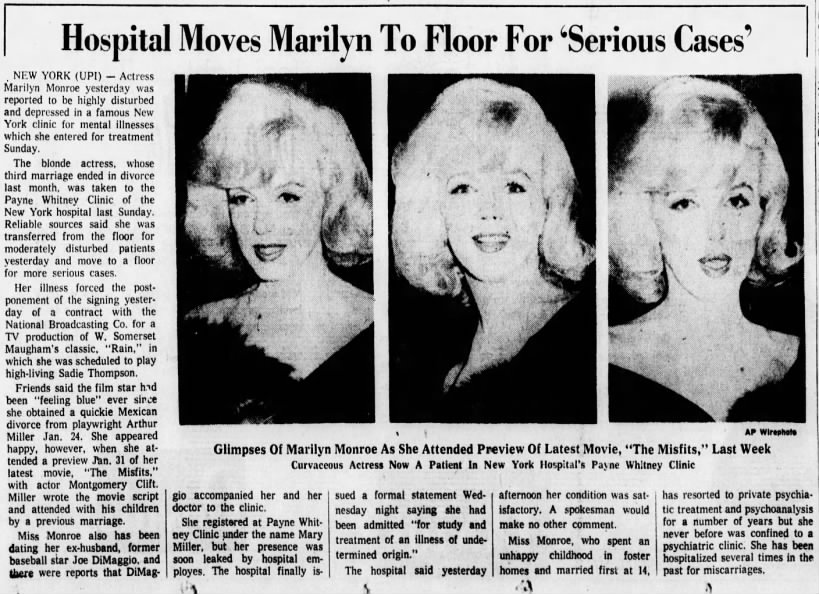
Later that day, sources within the hospital confirmed Marilyn got moved to a more severe ward:
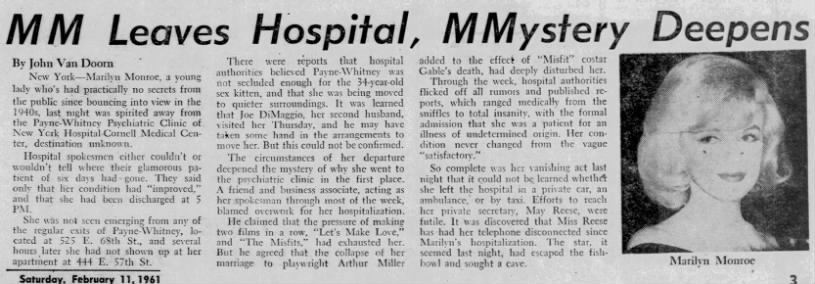
Marilyn then checked out of the hospital on the night of the 10th, leading to ever-increasing coverage about where she was headed:
Ralph Roberts, Marilyn’s masseuse, would recall the following:
“She was admitted by Dr. Kris to the Payne-Whitney Clinic under the name of Faye miller. Unfortunately, the lines of communication somehow got messed up. Instead of being placed in a section reserved for patients with [pill addictions], she was put into a section that housed the mentally ill. Barred windows and door, the latter glass – through which nurses, orderlies and other passers-by could look.”
Ralph Roberts, Mimosa, pg. 111.
Roberts goes on to recall Marilyn telling him she maneuvered herself to a pay phone and called Joe DiMaggio in the hopes he would get her out. This is where the famous “brick by brick” story comes into play (although Roberts doesn’t relay this, simply saying Marilyn believed “God again did His magic” by letting DiMaggio answer the phone). In reality, Dr. Kris secured her release after DiMaggio alerted her to the phone call. Reportedly, Roberts picked her up with Kris. Once Marilyn saw her psychiatrist, she lambasted her while Kris wept, with the latter only able to mutter, “I’ve done a terrible, terrible thing.”*
Roberts goes on to say that night was spent with Aaron Fosch, Kris, DiMaggio, the Strasbergs and (by telephone) Greenson to discuss what to do with Marilyn. It was decided she should still receive medical treatment, but at a different facility. This led to her getting admitted to Columbia Presbyterian on either the night of the 10th or the morning of the 11th:

During her time at Columbia, Marilyn wrote a very long letter to Greenson, which reads:
“Just now when I looked out the hospital window where the snow had covered everything suddenly everything is kind of muted a green. The grass, shabby evergreen bushes — though the trees give me a little hope — the desolate bare branches promising maybe there will be spring and maybe they promise hope.
Did you see ‘The Misfits’ yet? In one sequence you can perhaps see how bare and strange a tree can be for me. I don’t know if it comes across that way for sure on the screen — I don’t like some of the selections in the takes they used. As I started to write this letter about four quiet tears had fallen. I don’t know quite why.
Last night I was awake all night again. Sometimes I wonder what the night time is for. It almost doesn’t exist for me — it all seems like one long, long horrible day. Anyway, I thought I’d try to be constructive about it and started to read the letters of Sigmund Freud. When I first opened the book I saw the picture of Freud inside opposite the title page and I burst into tears — he looked very depressed (which must have been taken near the end of his life) that he died a disappointed man — but Dr Kris said he had much physical pain which I had known from the Jones book — but I know this too to be so but still I trust my instincts because I see a sad disappointment in his gentle face. The book reveals (though I am not sure anyone’s love-letters should be published) that he wasn’t a stiff! I mean his gentle, sad humor and even a striving was eternal in him. I haven’t gotten very far yet because at the same time I’m reading Sean O’Casey’s first autobiography –(did I ever tell you how once he wrote a poem to me?) This book disturbs me very much in a way one should be disturbed for these things –after all.
There was no empathy at Payne-Whitney — it had a very bad effect — they asked me after putting me in a ‘cell’ (I mean cement blocks and all) for very disturbed depressed patients (except I felt I was in some kind of prison for a crime I hadn’t committed. The inhumanity there I found archaic. They asked me why I wasn’t happy there (everything was under lock and key; things like electric lights, dresser drawers, bathrooms, closets, bars concealed on the windows — the doors have windows so patients can be visible all the time, also, the violence and markings still remain on the walls from former patients). I answered: ‘Well, I’d have to be nuts if I like it here’ then there screaming women in their cells — I mean they screamed out when life was unbearable I guess — at times like this I felt an available psychiatrist should have talked to them. Perhaps to alleviate even temporarily their misery and pain. I think they (the doctors) might learn something even — but all are only interested in something from the books they studied — I was surprised because they already know that. Maybe from some live suffering human being they could discover more — I had the feeling they looked more for discipline and that they let their patients go after the patients have ‘given up.’ They asked me to mingle with the patients, to go out to O.T. (Occupational Therapy). I said: ‘And do what?’ They said: ‘You could sew or play checkers, even cards and maybe knit.’ I tried to explain the day I did that they would have a nut on their hands. These things were furthest from my mind. They asked me why I felt I was ‘different’ (from the other patients I guess) so I decided if they were really that stupid I must give them a very simple answer so I said: ‘I just am.’
The first day I did ‘mingle’ with a patient. She asked me why I looked so sad and suggested I could call a friend and perhaps not be so lonely. I told her that they had told me that there wasn’t a phone on that floor. Speaking of floors, they are all locked — no one could go in and no one could go out. She looked shocked and shaken and said ‘I’ll take you to the phone’ — while I waited in line for my turn for the use of the phone I observed a guard (since he had on a grey knit uniform) as I approached the phone he straight-armed the phone and said very sternly: ‘You can’t use the phone.’ By the way, they pride themselves in having a home-like atmosphere there. I asked them (the doctors) how they figured that. They answered: ‘Well, on the sixth floor we have wall-to-wall carpeting and modern furniture’ to which I replied: ‘Well, that any good interior decorator could provide — providing there are the funds for it’ but since they are dealing with human beings why couldn’t they perceive even an interior of a human being.’
The girl that told me about the phone seemed such a pathetic and vague creature. She told me after the straight-arming ‘I didn’t know they would do that.’ Then she said ‘I’m here because of my mental condition — I have cut my throat several times and slashed my wrists’ –she said either three or four times.
I just thought of a jingle:
‘Mingle – but not if you were just born single’
Oh, well, men are climbing to the moon but they don’t seem interested in the beating human heart. Still one can change but wont — by the way, that was the original theme of THE MISFTIS — no one even caught that part of it. Partly because, I guess, the changes in the script and some of the distortions in the direction and …..
LATER WRITTEN
I know I will never be happy but I know I can be gay! Remember I told you Kazan said I was the gayest girl he ever knew and believe me he has known many. But he loved me for one year and once rocked me to sleep one night when I was in great anguish. He also suggested that I go into analysis and later wanted me to work with his teacher, Lee Strasberg.
Was it Milton who wrote ‘The happy ones were never born.’ I know at least two psychiatrists who are looking for a more positive approach.
THIS MORNING, MARCH 2
I didn’t sleep again last night. I forgot to tell you something yesterday. When they put me into the first room on the sixth floor I was not told it was a Psychiatric floor. Dr. Kris said she was coming the next day. The nurse came in (after the doctor, a psychiatrist) had given me a physical examination including examining the breast for lumps. I took exception to this but not violently only explaining that the medical doctor who had put me there, a stupid man named Dr. Lipkin had already done a complete physical less than thirty days before. But when the nurse came in I noticed there was no way of buzzing or reaching for a light to call the nurse. I asked why this was and some other things and she said this is a psychiatric floor. After she went out I got dressed and then was when the girl in the hall told me about the phone. I was waiting at the elevator door which looks like all other doors with a door-knob except it doesn’t have any numbers (you see they left them out). After the girl spoke with me and told me about what she had done to herself I went back into my room knowing they had lied to me about the telephone and I sat on the bed trying to figure if I was given this situation in an acting improvisation what would I do. So I figured, it’s a squeaky wheel that gets the grease. I admit it was a loud squeak but I got the idea from a movie I made once called ‘Don’t Bother to Knock.’ I picked up a light-weight chair and slammed it, and it was hard to do because I had never broken anything in my life — against the glass intentionally. It took a lot of banging to get even a small piece of glass – so I went over with the glass concealed in my hand and sat quietly on the bed waiting for them to come in. They did, and I said to them ‘If you are going to treat me like a nut I’ll act like a nut.’ I admit the next thing is corny but I really did it in the movie except it was with a razor blade. I indicated if they didn’t let me out I would harm myself — the furthest thing from my mind at that moment since you know Dr. Greenson I’m an actress and would never intentionally mark or mar myself. I’m just that vain. Remember when I tried to do away with myself I did it very carefully with ten Seconal and ten tuonal and swallowed them with relief (that’s how I felt at the time.) I didn’t cooperate with them in any way because I couldn’t believe in what they were doing. They asked me to go quietly but I refused to move staying on the bed so they picked me up by all fours, two hefty men and two hefty women and carried me up to the seventh floor in the elevator. I must say at least they had the decency to carry me face down. You know at least it wasn’t face up. I just wept quietly all the way there and then was put in the cell I told you about and that ox of a woman one of those hefty ones, said: ‘Take a bath.’ I told her I had just taken one on the sixth floor. She said very sternly: ‘As soon as you change floors you have to take another bath.’ The man who runs that place, a high-school principal type, although Dr. Kris refers to him as an ‘administrator’ he was actually permitted to talk to me, questioning me somewhat like an analyst. He told me I was a very, very sick girl and had been a very, very sick girl for many years. He looks down on his patients because I’ll tell you why in a moment. He asked me how I could possibly work when I was depressed. He wondered if that interfered with my work. He was being very firm and definite in the way he said it. He actually stated it more than he questioned me so I replied: ‘Didn’t he think that perhaps Greta Garbo and Charlie Chaplin perhaps and perhaps Ingrid Bergman they had been depressed when they worked sometimes but I said it’s like saying a ball player like DiMaggio if he could hit ball when he was depressed.’ Pretty silly.
By the way, I have some good news, sort of, since I guess I helped, he claims I did. Joe said I saved his life by sending him to a psycho-therapist; Dr. Kris says he is a very brilliant man, the doctor. Joe said he pulled himself up by his own bootstraps after the divorce but he told me also that if he had been me he would have divorced him too. Christmas night he sent a forest-full of poinsettias. I asked who they were from since it was such a surprise, (my friend Pat Newcomb was there)– they had just arrived then. She said: ‘I don’t know the card just says ‘best, Joe.’ Then I replied: ‘Well, there’s just one Joe.’ Because it was Christmas night I called him up and asked him why he had sent me the flowers. He said first of all because I thought you would call me to thank me and then he said, besides who in the hell else do you have in the world. He said I know I was married to you and was never bothered or saw any in-law. Anyway, he asked me to have a drink some time with him. I said I knew he didn’t drink — he said he now occasionally takes a drink — to which I replied then it would have to be a very, very dark place. He asked me what I was doing Christmas night. I said nothing, I’m here with a friend. Then he asked me to come over and I was glad he was coming though I must say I was bleary and depressed but somehow still glad he was coming over.
I think I had better stop because you have other things to do but thanks for listening for a while.
Marilyn M.
PS: Someone when I mentioned his name you used to frown with your moustache and look up at the ceiling. Guess who? He has been (secretly) a very tender friend. I know you won’t believe this but you must trust me with my instincts. It was sort of a fling on the wing. I had never done that before but now I have – but he is very unselfish in bed.
From Yves I have heard nothing – but I don’t mind since I have such a strong, tender, wonderful memory.
I am almost weeping…..”
April VeVea, Marilyn Monroe: A Day in the Life, pgs. 291-296
Sources claim this is when Marilyn started seeing Greenson exclusively, but Guiles relayed that Monroe saw Kris until her move to Los Angeles. Greenson himself would recall she started seeing him in July of 1961.
I want to point out that, regardless of what people claim, it’s impossible to know exactly what Greenson inherited with Marilyn. Her treatment plan with Kris is unknown beyond billing information; however, it’s safe to say it was likely close to what Greenson worked with minus the whole “come meet my family” aspect. Regardless, by December, Greenson found himself struggling, writing to Anna Freud:
“I took over the treatment of a patient that Marianne Kris had been treating for several years, and she has turned out to be a very sick borderline paranoid addict, as well as an actress. You can imagine how terribly difficult it is to treat someone with such severe problems and who is also a great celebrity and completely alone in the world. Psychoanalysis is out of the question and I improvise, often wondering where I am going, and yet have nowhere else to turn. If I succeed I maybe learned something, but it takes a tremendous amount of time and also emotion.”
Ralph Greenson to Anna Freud, December 4, 1961
Freud responded on December 29, 1961, saying, “I know about Marianne Kris’ patient and her own struggles with her. She seemed a worthwhile person from Marianne’s description. The question is whether one can supply her impetus to get well which she ought to have herself.”
1962
The correspondence between Greenson and Freud would continue until after Marilyn passed away, with Greenson finding their working relationship more and more difficult as demonstrated by their letters:
“Hildi is leaving for Switzerland on May 1. If all goes well I will join her in Rome on the 10th, will give a paper in Jerusalem and then visit Greece and go for a rest in Switzerland. I need a rest but there will be uncertainty about this trip until I leave. The one sick patient I once mentioned to you teeters on the verge of establishing her independence or regressing and destroying my trip. I think she will succeed in living without me, but I am not sure I will survive this.”
Greenson to Freud, April 29, 1962
“Since I returned home she felt much better and was able to resume work. Nevertheless, the studio fired her the day after I returned for a variety of other reasons. This was a most frustrating experience, since now I was back home and she was feeling fine and therefore I was free to return to Europe, which was impossible.”
Greenson to Freud, June 22, 1962
“As you can imagine, I have tried to follow your fate in the newspapers and I saw your patient was acting up. I wonder what will happen to her and with her. There must be something very nice about her from what I understand from Marianne Kris. And still, she is evidently far from being an ideal analytic patient.”
Freud to Greenson, July 2, 1962
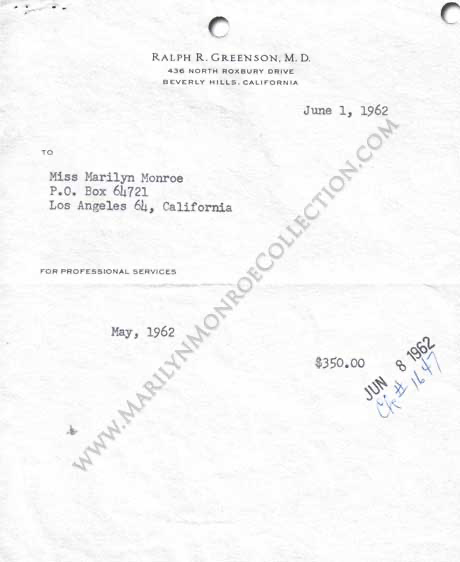
During this time, Greenson found himself getting more and more entwined with Marilyn. He found her demanding and all-consuming, but still felt sympathetic towards her. Again, I am not saying his treatment plan was the best course of action–after all, she ended up passing away–but it’s evident she was a ticking time bomb. Bills show a steady regimen of visits:
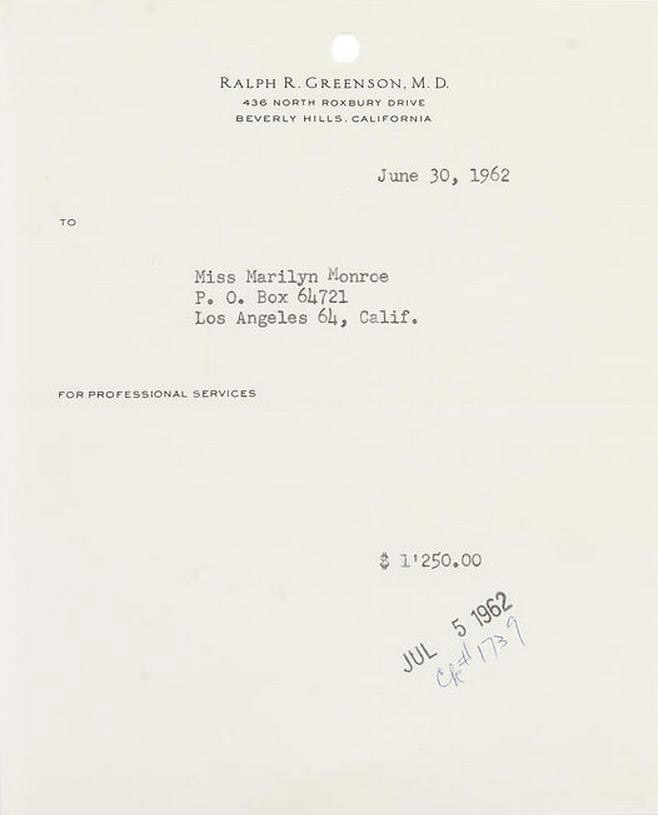

Greenson’s obvious struggles with his own feelings are evident. He voiced his feelings roughly two weeks after Marilyn passed away, in the following letter to Marianne Kris:
“Dear Marianne:
I have been waiting for your letter and it was good to receive it because now i think I can start to attempt to really get over this terrible experience. It has been a very painful experience, in some ways the most painful of my entire life. First of all, she was a patient, such a perpetual orphan that I felt even sorrier and she tried so hard and failed so often, which also made her pathetic and we had both worked very hard, and the ending at this particular time seemed so unfair and in way unnecessary, and I feel that I have hurt my family with this since they all got to know her and cared about her. And on top of it all the notoriety, the press all over the world writing about it and constantly linking my name with this tragic event, and often so wrongly. Let me give you a brief outline of what has been going on:
A year ago in July, Marilyn came out to begin consistent treatment with me, and I was going to be her one and only psychiatrist. At that time she was recovering from gallbladder surgery. She was taking very little medication, but she was terribly, terribly lonely. As consequence she became involved with people who hurt her and evoked in her this feeling of mistreatment which had paranoid undertones to it. She lived in a little apartment which she tried to furnish and I saw her at that time seven days a week, mainly because she was lonely and had no one to see her, nothing to do if I didn’t see her.
Two things became very clear to me in her treatment. One was that she could not bear the slightest hint of anything homosexual. She had an outright phobia of homosexuality and yet unwittingly feel into situations which had homosexual coloring, which she then recognized and projected onto the other, who then became her enemy. For example, she became friendly with a girl named Pat and then one day she saw that Pat had dyed her hair with a streak resembling Marilyn’s hair color. Marilyn instantly interpreted this that this girl was trying to take possession of her by becoming like her. She sensed instantly that identification means homosexual possessiveness. Then she burned with a fury against this girl and accused her of trying to rob her of a most valuable possession. Any attempt to interpret this was disastrous. All one could do was agree there was something intrusive about Pat’s behavior, and all one could ask Marilyn to do would be to moderate her reactions. Anything more brough panic, rage, etc. Once i said to Marilyn deliberately, casually, of course; you know that all of us both have hetero and some homosexual components. Marilyn reacted though this were a revelation and a catastrophe. I finally had to tell her that the relative percentage of those components varied greatly and that she probably had only 1% homosexuality and was more than 102% heterosexual.
The other area which Marilyn could not handle at all was to recognize she could feel hostility or antagonism or anger to me. If I behaved in a way which hurt her she reacted as though it was the end of the world and could not rest until peace had been re-established, but peace could be reconciliation and death. As a consequence I became aware that any negative transference required instant handling, with the result that she would call me at all hours of the day and night, whenever any negative transferences cropped up. Incidentally, to her certain ideal figures in her life existed toward whom she reacted in a similar way, so that one had to protect Uncle Wayne and Aunt Anna in the same way and only gently, most gently, could one begin to intimate these people had their limitations too.
I have mentioned these points in some detail because I feel they were ultimately the decisive factors which led to her death. As I said, I saw her 7 days a week because she was terribly lonely, the more so as she began to get rid of a lot of people around her whole only took advantage of her. Nevertheless she worked well and I suggested to her that she look for a little house which she could buy so that she could have a place of her own, a piece of ground which was here and she could therefore stop being an orphan and a waif and homeless. Slowly this idea began to be more appealing to her and the biggest spurt in her treatment came when she bang to fully furnish such a house which in many ways was similar to mine. In November she went through a severe depressive and paranoid reaction precipitated by her disappointment in me when one day I became somewhat impatient with her constant complaints about this one and that one who were persecuting her, taking advantage of her, because they were male homosexuals who hated women. I did not deny the fact that I was somewhat impatient, but she took this to mean that I too could some day throw her out. She talked about retiring from the movie industry, killing herself, etc. I had to place nurses in her apartment day and night and keep strict control over her medication, since I felt she was potentially suicidal. Incidentally, I had one internist who would prescribe medication for her and to give her some vitamin injections so that I had nothing to do with the actual handling of her medication. I only talked about it with her and he kept me informed. Marilyn fought with these nurses, so that after a few weeks it was impossible to keep any of them. I was forced to get an elderly housekeeper who could look after Marilyn at night and stay in the house with her, and for some period of time I let Marilyn spend some extra time at my house because this older housekeeper needed a goodly amount of time off and there was nobody else around who I could trust. As a consequence she got to know Hildi and Danny and Joanie, and formed a very strong friendship with Joanie. Later on she became very friendly with Danny and even eventually Hildi. During this period she made progress and found a little house, so that after a few months I was able to say to her some time in January that she was now well enough to go back to having just a regular session with me and she did not need to spend all that extra time at my home. I also suggested that to handle some of her difficulties with the press, with the movie studio, etc., she should get a special person, etc. Marilyn could accept this at this time and did not take this as a rejection but as a sign of her improvement.
In January she moved into her new home, flew to Mexico to buy furniture for it, since it was a Mexican house, and she had made a real stride. I saw her for her regular sessions and on Saturday and Sunday only when she was particularly lonely or depressed. She began to look forward to doing a movie. Nevertheless, there were always these constant periods when somebody mistreated her and and there was always some reality to this mistreatment and Marilyn took this as a sign of life and humanity and people being against her and she would react with some form of depression plus anger or resignation or paranoid feelings. At these times the drug problems could become serious and one would have to be particularly careful, and I sometimes had to spend three and four and five hours with her at a time in order to help her get over the acute episode. This always worked but I had become a prisoner now of a form of treatment which I thought was correct for her but almost impossible for me. I realized after the fact I was trying to create a foster family for her, my own, but a good foster family who would not throw her out like all the others had. I was her therapist, the good father who would not disappoint her and who would bring her insights, and if not insights, just kindness. She was making progress, but at times I felt I could not go on with this, particularly since so often it became 6 and 7 days a week. Yet but this time I had become the most important person in her life and there was nothing I could do except hope that as she improved still more she would become more independent. I also felt guilty that I put a burden on my own family, but there was something very lovable about this girl and we all cared about her and she could be delightful.
I don’t want to go on with all this detail and now I suddenly wonder why I am telling you all this. I suppose because I have some misgivings about how correct was I in my form of treatment and how much was I being led by countertransference feelings and that now I want to justify myself. At any rate, I will now be brief:
Hildi’s mother had a stroke in February and I thought Hildi ought to visit her, but Hildi was afraid to leave me home alone. We soon heard that the stroke was not that severe, so that Hildi could wait. Marilyn was supposed to start a picture in March and I felt that if I stayed with her during the first two months of the picture and if it went well, I could go with Hildi to Europe. The picture kept getting postponed from week to week. Marilyn developed a sinus infection. The story had many errors in it and had to be re-written. And for one reason or another the picture did not begin until after I left, which was on May 10. I left Marilyn in the hands of a colleague whom she knew and I told her that I would return if it was necessary. As you know, after three weeks my colleague called me, and finally she called me, and I returned to Los Angeles.
She was depressed, but within 24 hours of my return she was bounced up again and I reported to the movie studio that she would return to work within 48 hours. They, however, in their fury at Elizabeth Taylor, decided to fire Marilyn, which they did. This led again to several depressive reactions, but again she seemed to be mastering them. We were working along quite well until the day of her death.
In her Friday hour she became angry and resentful towards her friend Pat. I could not understand the reason for this resentment. However, I sided with Marilyn and only asked her not to be too angry because then she would feel guilty. Apparently she saw this girlfriend on Friday night and they continued quarreling but not very intensively. This girlfriend stayed over night in the house and I received a call from Marilyn at 4:30 in the afternoon. She seemed somewhat drugged and somewhat depressed. I went over to her place and talked with her for about 2.5 hours. She was still angry with her friend who had slept 15 hours that night and Marilyn was furious because she had poor sleep. I finally asked the girlfriend to leave because this was Marilyn’s request, and I asked the housekeeper to stay overnight, which she did not ordinarily do on Saturday nights. Marilyn wanted to go for a walk on the pier in Santa Monica, and I said she was too groggy for that but if she drank a lot of fluid I would allow the housekeeper to drive her to the beach. When I left at 7:15, She seemed somewhat depressed but I had seen her many times before in much worse condition. Yet I also was aware that she was somewhat annoyed with me. She often became annoyed when I did not absolutely and whole heartedly agree with her accusations against her girl friends. In this particular situation, I agreed with her, but not whole heartedly. She sensed it and was angry with me. I told her to call me on Sunday morning when she awakened, and I left. A half hour later she phoned me at home to tell me she had gotten some good news and she seemed quite pleasant and more cheerful. At the end of the conversation she asked me whether I had taken her Nembutal bottle. I was surprised that she asked me that because I did not know she was taking Nembutal. She had stopped taking all barbiturates for three weeks. I later found out that on Friday night she had told the internist that I had said it was all right for her to take some nembutal, and he had given it to her without checking with me, because he has been upset himself for his own personal reasons. (He had just left his wife after some 27 years of marriage). I said to Marilyn I did not take her Nembutal, and I didn’t know she was taking Nembutal. and she quickly dropped the subject and I thought perhaps she was just confused. At any rate, she sounded pleasant on the phone, although somewhat depressed, but by no means acutely so. About an hour later, someone called the housekeeper and said that Marilyn had sounded funny on the phone, but the housekeeper said that Dr. Greenson had just been there and she did not want to disturb Marilyn. At midnight, the housekeeper awakened and saw that there was lights on in Marilyn’s room which was most unusual. The housekeeper was afraid to awaken Marilyn who would have become enraged, and so she fell asleep again. At 3:30 am the housekeeper awakened and saw the light and phoned me. I was there in five minutes, broke the window in the bedroom, found Marilyn lying dead, clutching at the phone in her hand so strongly that I could not remove it. It seems she had died around midnight. I of not think she consciously wanted to die at this moment but expected to be rescued; this time, however, it failed.
As you can imagine, the whole family was terribly shocked. They all wept and felt terribly sorry for poor Marilyn. I was particularly touched by Joanie who said through her tears. ‘I am glad you brought Marilyn into our life, even though it ended this way, and I know you did what was right.’ I did not speak to the press at all, although I was besieged by phone calls from all over the world. I received many terrible letters from people, accusing me of being a murderer, or going after her money, and not believing in God, etc. I received some very friendly letters, however, also from people who were concerned about my feelings. I am amazed how deeply people seem to be affected by this death. Everybody felt sorry for her and so many felt guilty. She was a Cinderella girl who did not live happily ever after. It is a sad, sad story and it will take me some time to get over it.”
Ralph Greenson to Marianne Kris, August 20, 1962
After 1962
There’s a lot to unpack with the historiography of Greenson regarding Marilyn post-1962. We could be here for days looking at how each biography has portrayed him. He only spoke a few times to the press following Marilyn’s death, and each time was to work on defending her. The most famous defense from him comes via a 1973 Medical Tribune article where he laments no one who knew her was defending her memory after the Norman Mailer “biography.”
With Greenson’s death in 1979, the door opened for the unscrupulous to accuse him of murder. Although Greenson didn’t necessarily possess a sterling reputation with Monroe biographers before his death, anything goes for writers once the subject is dead. Greenson morphed from a bizarre, reserved figure to the ultimate boogieman, keeping Marilyn in a constant state of fear. One day he snapped and killed her, whether through a poisoned enema (debunked) or an injection in the heart (also debunked).
Today, there’s a strange campaign to get locked UCLA files donated by Greenson unlocked because some quack investigator believes they hold some secret to Marilyn’s death. Like Greenson was just going to hand over some murder evidence to UCLA? Asinine. In actuality, these files were open for nearly 15 years until Donald Spoto made up stories about Greenson in an attempt to put the Kennedy rumors to rest. Although his research about the Kennedy-Monroe connection is great, starting a whole new conspiracy theory to sell books is one of the reasons I no longer recommend the book.
If Greenson hadn’t passed away when he did, more focus would likely fall on Dr. Engelberg, the internist Greenson mentions above. However, that’s a post for a different day.
*This is located in Spoto’s book but not Roberts’ Mimosa.

 Classic Blondes
This is a great post. I neither feel that Greenson is Satan or an Angel. He seems to struggle with his own mental illness and was using a Freudian system that is to say the least, problematic. I think it’s a mistake to view Marilyn as a time bomb. The medication she was on, Greenson said “take this medicine and imagine it’s me” causes depression. This quote from him is also alarming. We have no idea who had a hang up on gender identity and sexuality since we are only getting his account and his investment and feelings in this are complicated. I don’t think any one individual is responsible for Marilyn’s death but both of her doctors played a role. No one should have those drugs and no one deemed suicidal should have that cocktail in their home.
LikeLike
Well said, Tina!
LikeLike
sorry, Greenson is being self serving. The key to the whole thing is he was trying to get MM only on chloral hydrate for sleep and nothing else. A noble thing as its milder. It simply didnt work most of the time. She got no sleep fri nite while on it and was in bad shape from lack of sleep sat. She was taking Nembutal off and on Sat to calm her nerves as she was letting Eunice go and perhaps ceasing therapy with greenson, so it was something of a crisis day. Greenson himself said she seemed somewhat drugged on Sat and knew she had access to nembutal. He knew the combination of Nembutal and Chloral hydrate could be deadly, or should have known as an MD. I firmly believe he authorized a chloral hydrate doseage thru an enema as opposed to an injection. He felt MM was physiologically resisting the chloral hydrate and getting it directly into the bloodstream would put her to sleep as opposed to taking the med orally. Thus the enema sat PM as he couldnt reach the internist who normally administered injections. Greenson didnt give the meds directly for whatever bizarre reason. He had Eunice administer the doseage. THe combination was just enuf to put MM over the edge and death. It was a catastrophic mistake and Greenson in my opinion was out of control/obsessed with MM and should have handed off the treatment to someone else months earlier.
LikeLike
Sorry, but that’s primarily nonsense stemming from Spoto’s half-baked theories.
LikeLike
I found it suspicious that I heard or read years ago that Greenson would give MM enemas. Medicated perhaps???? Also strange that another of his patients died of same drug overdose around same age as MM, that is Inger Stevens. I would wonder if she too was receiving enemas.
LikeLike
The enemas theory comes from Spoto. Greenson didn’t deal with medication for Marilyn, and I very much doubt he would’ve administered an enema to Monroe. Stevens, unfortunately, had a lot of mental health problems like Monroe did, and Greenson’s Freudian analysis simply wasn’t able to help either woman.
LikeLike